Visit our new site at revgalblogpals.org.

Showing posts with label Book recommendations. Show all posts

Monday, August 26, 2013

RevGalBookPals: Love and Salt

I have to confess that I'm an inveterate writer of real letters, the sort where you scratch out words, twine a last minute addition to a paragraph around the edge of the paper, and tenderly fold up to slip into an envelope.  I love the physicality of putting pen to paper, and delight in the thought that this object I have put my hand to will land in the hands of someone I care about.  And to find a letter or a postcard in my mailbox in return is a unlooked for but utterly delightful grace.  

So when I heard Amy Andrews and Jessica Mesman Griffith, the authors of Love and Salt: A Spiritual Friendship Shared in Letters talking about their exchange of letters last April I added it to the top of my summer reading list. 

Amy Andrews and Jessica Mesman Griffith met in a creative writing workshop while they were graduate students in Pittsburgh.  On a class trip to New York City, they came across a copy of the Book of Ruth and were captured by the line
Whither thou goest, I will go
Thy God shall be my God.
A few months later Amy moved to Chicago to teach math and Jessica took a job at Notre Dame.  When Amy, who had grown up with a religious bent in an agnostic household, decided to become a Roman Catholic, she asked Jess to accompany her through the process, to be her sponsor.  Jess vows to write a letter (not an email!) to Amy every day during Lent, and Amy decides to write in return.  They continued to write to each other intermittently over the next five years, writing they say,
"...to preserve and make sense of our daily lives; we wrote to confess and console, to rant and grieve.  But more than anything else, we wrote because it was the only way we know how to pray...In our letters, we wrote ourselves back to belief."  [p. xi]
I suspect many of us who blog and preach have walked this path. Writing is a way into a relationship between God and ourselves, our friends, our congregations and our readers.  We write, to paraphrase CS Lewis, because we can't help ourselves; we write because we're helpless; we write because the need flows out of us all the time — waking and sleeping; we write, not to change God — but to change ourselves.  

In these letters, Jess and Amy share their joys and concerns around faith and God and religious practice, the whole of it wound into the fabric of their everyday lives: birthdays, basketball games, and baptisms.  Above all it recounts their journey of faith; not one that is piously placid, but one that takes them through lands that are green and through howling deserts.  It is not a journey that leaves either Amy or Jess unscarred.  There is love and there is salt.

Though there is a natural narrative arc to the collection of letters, loosely organized around the liturgical calendar — Lents, Easters and Ordinary Time —  it is not a book to be drunk too quickly.  I read it in short pieces over two months, and even then it felt like I was moving too fast.  I wanted to hold this faith journey gently, to listen to Jess and Amy's story, to hear in it echoes of all our faith lives.  At this point, I couldn't share my copy with anyone, I wrote so many notes to myself in the margins.  

[Spoiler alert:  Since this isn't a novel, I'm not sure there is anything to spoil, but just in case you want to let the journey unfold in its own way, without knowing much about the events that shape it, skip to the last paragraph.]

If you are still with me, know that the second part of this book is what makes the title so apt, and for me, so powerful.  Both Jess and Amy become mothers in 2006. Jess to Charlotte, Amy to Clare.  Clare dies just before she is born.  Amy struggles with God, with fear, with rending grief, as she mourns Clare and then becomes pregnant with a son, John.  Jess struggles with being alone with a newborn while her husband is away working in another city.  Through their letters, and in person, they walk with each other, grieving, listening, a ministry of steadfast presence, whither you go:  
"Again, the consolation was not of relief, but accompaniment." [p. 254]
says Amy of two aunts who drove miles to be with her at Clare's burial.

The letter format means that the raw roller ride of grief is very evident, as good and bad days are swirled together.  Having lived through a similar period of wrenching grief in my twenties, I can remember the odd way that joy and pain wound around each other in those days, and wish that I had known that this storm tossed pattern was normal, or as normal as anything can be in such times.  

In summary, this is an exquisite book. Read it if you want to see how faith looks when it is clothed in doubt, rings with joy, is rent by grief, when it comes alive in our messy human lives.  I'm hoping it inspires a host of similar exchanges, whether on paper or electronically or shared over coffee.  
  • What inspires you to put pen to paper and add a stamp?
  • Have you ever carried on a sustained correspondence, either through email or on paper?  or dreamed of doing it?
  • Thomas Merton noted in a journal, "To write is to think and to live — even to pray."  Do you find writing to be a way to pray?  
Share your thoughts in the comments!

______

I bought a physical copy of this book from Amazon, and page citations refer to that version.

Monday, July 29, 2013

RevGalBookPals: The Fourth Gospel: Tales of Jewish Mystic

Confession: I do not hurry out and read books that have (I assume) premises with which I do not agree. I don’t read books that argue against the ordination of women, for example, or posit theories on specific literal signs of the apocalypse. I don’t have the time nor the blood pressure medication. (I do read books about other religions/belief systems to gain insight and knowledge.)


However, I do occasionally read books that I know will push me in my own faith journey and experience with God. This was DEFINITELY my experience with John Shelby Spong’s new book, The Fourth Gospel: Tales of a Jewish Mystic.* I purchased the book to read as part of my preparation for next year’s Narrative Lectionary, the gospel section of which will focus on John. My experience with Spong has been that he usually writes a little more than I can swallow, but my tastes are still
expanded (so to speak).

The Fourth Gospel, however, was beyond the challenge I expected. I was prepared to run a mental marathon, but once on Spong’s track… I discovered this work to be an Ironman event. I’m still panting- days later.

I hesitated to do another year of the Narrative Lectionary because I have very mixed feelings about the gospel according to John. Spong neatly sums up some of his prior objections to this gospel account and I agreed with this assessment:

Throughout most of my professional career I was not drawn to the Fourth Gospel; indeed I found it almost repellent. This gospel present, I believed, a Jesus whose humanity was no longer intact. John’s Jesus claimed pre-existence- that is, he said he came to this earth from another life in another place. He was portrayed as possessing clairvoyance- that is, he knew about people’s lives and their pasts before he met them. He was ever said to know what they were thinking while he was talking to them. The Jesus of John’s gospel also seemed to endure crucifixion without suffering… Because this book was thought to have spelled out “orthodox Christianity”, John’s gospel also helped to fuel such dreadful events in Christian history as heresy hunts and the Inquisition.” (19)

Exactly. I have always struggled with how “magic” Jesus seemed in John. Spong argues that this representation has stemmed from a chronic and willful misinterpretation of the origin of this gospel, its reason for being, and its mystical nature. Mysticism isn’t magic- it’s about a greater and broader understanding that cannot be attained through any literal application or interpretation.

Spong writes that the Fourth Gospel has been understood as an anti-Semitic polemic precisely because centuries of readers have not been trained to recognize the symbolism of the book and its specific Jewish character and characters. He makes this argument persuasively, but not always convincingly (to me).
Keep in mind that the followers of Jesus in the Johannine community were themselves overwhelmingly Jews. This talk of “the Jews” in the text of the Fourth Gospel did not mean ethnic Jews for that would have included the community itself. It meant rather those Jews who were the synagogue leaders and thus the people who had excommunicated the followers of Jesus. This split shaped the Johannine community dramatically and not surprisingly it also shaped the gospel narrative that this community produced as that text journey toward its final form. (33)

            Spong’s exposition of the Fourth Gospel as a mysticism is rooted in his revelation that John is not writing a historical account, but a theological framework for how the Johannine community can go forward. Many contemporary Christians have moved to a place of understanding the gospels as non-historical accounts, but I am not certain how many are prepared to accept that they are non-literal accounts. In particular, I do not know how it would be received in my current context if I put forth that everything in the Fourth Gospel is symbolic and did not literally happen at any point in the life of Jesus.  These latter two points are Spong’s.

One cannot be mystical in one’s approach to God and still be literal about the symbols one uses for God. Indeed the very idea of the mystical means that words cannot capture it. Mysticism expands words beyond their normal limits and calls the mystic into the ultimate experience of wordlessness. The best that words can do is point beyond themselves to a new reality… Literalism suggests that words, which are only pointers, can in fact be made concrete, thus establishing assumptions that can never be demonstrated. Literalism commits us to the presumption that any religious form can not only capture truth, but can explain it fully… Literalism is thus always the enemy of faith, which is ultimately the opposite of certainty. (72)

I appreciate the wisdom in this passage. I want to believe that I embrace its truth. Then, I consider what Spong will go on to say- that the resurrection of Lazarus is symbolic, the person of Judas is symbolic, the healings are symbolic, and even the resurrection account of Jesus’ own self is not literal. Suddenly I am wondering, with Pilate, “What is truth?”

 This gospel is not about God becoming human, about God putting on flesh and masquerading as a human being; it is about the divine appearing in the human and calling the human to a new understanding of what divinity means. It is about bring God out of the sky and redefining God as the ultimate dimension of the human. It is about the spirit transcending the limits of the flesh, not in some pious or religious sense, but in opening the flesh to all that it means to be human. It about seeing Jesus as the doorway into a new consciousness, which is also a doorway into God, who might be perceived as a universal consciousness. (77)

I have not even covered half of the book yet. Spong’s development of the characters and stories of John as symbols is fascinating, but I remained somewhat skeptical. The question would be then, in Spong-ian analysis, am I skeptical because I am unwilling to embrace the ultimate light? Am I willing to accept the vulnerability of trust in a non-literal account of Jesus and allow the Spirit to move me from self-consciousness into God-consciousness, into connection with the God of all being? Do I have the courage to be one with God in the way that Jesus was and in the way that Jesus promised to his followers?

I don’t know, but I do know that this book gave me a lot to think about. This might not be for your adult study group (or it might be), but I recommend it if your Johannine diet or exercise regime needs variety or expanding.


I purchased this book through iBooks and all citations are from that version.


* Full disclosure: I believe John Shelby Spong is related to RGBP Director Martha Spong, but I am not sure how and Martha does not choose or influence what I review in this space. She had no prior knowledge of this selection nor has she influenced the review in any way. 

Monday, June 24, 2013

RevGalBookPals: Calling Me Home


I grew up in North Carolina (American South) in the 80s and 90s. I’ve lived and worked in the Northeast and Pacific Northwest of the United States, as well as in England for a time. I’ve traveled around a bit as well. So it is not without some experience that I say that I have never been anywhere that did not have some kind of racial or social tension. It is not always black and white. Sometimes it is indigenous and interloper. Sometimes it is an economic disparity- emphasized by color or ethnicity. It’s always been there. Someone always sighs and says, “Those people…” and a choice must be made by the hearer to call attention to subtle racism, overt bigotry, “gentlemen’s agreements”, and inappropriate assumptions that only serve to perpetuate the foundational lies of the unequal structures of our societies.

Regrettably, churches are not exempt from these behaviors.

With this in mind, I encourage you to read Calling Me Home by Julie Kibler. A novel less like The Help and more like Major Pettigrew’s Last Stand (read it!), it takes place in a time collapse between 1939 and the present day (whatever that might be). The premise of the story is a ninety-year-old white woman and a black woman in her mid-thirties on their way to a funeral. The younger woman, Dorrie, works as a hair dresser, with her own shop, and has done Isabelle’s hair for year. Their relationship has deepened, but only so far.

On the road trip to the funeral, Isabelle tells Dorrie the story of her first romance- her true love romance- with the son of her family’s housekeeper. Robert and Isabelle, black and white, were in love, but out of time in 1939 since her Kentucky hometown did not allow blacks to stay in the city limits after dark.

The writing is excellent and the dialogue is believable and warm. The truly villainous characters are a little two-dimensional, but they are also tertiary. The main characters are fully enfleshed and empathetic. The secondary personalities have enough character to make the reader care about them and be angry with them.

The story moves back and forth between the racial dynamics of the late 30s and of the “present-day”. If Isabelle is 90 and was 17 in 1939, the “present day” of the book is 2012. The tensions between Isabelle and Dorrie and strangers who encounter them on their road trip are all too real with a hotel manager who refuses to believe they’re together, restaurant patrons who stare, and a cop who grudgingly gives a speeding ticket to Dorrie because of Isabelle’s presence. The two women even have to deal with their own latent expectations and interpretations of one another’s behavior- always glimpsed through a lens of different races.

Church makes a brief active appearance in this book via the angry pastor who refuses to officiate a wedding for Robert and Isabelle and a kind clergyman who does officiate, after trying to dissuade them. Isabelle reflects later on the churches of her town that support the rules of city segregation. Church also serves as a backdrop for how they can meet and see one another.

As we mark the 50th anniversary of many significant events in the civil rights struggle in the United States, I’ve been reflecting on how far we have and have not come in those years. Regrettably, tensions still exist. The furor over a biracial family in a breakfast cereal ad proves that the Great Chain of Being still rules the thinking of a significant portion of the population.

Is the church still in this fight? Have we come to accept inequality, injustice, and social spacing as inevitable? Is the fight for racial parity on par with other social issues of our time or do we think it’s over? We cannot assume that part of the kingdom will come without our willingness to participate in the work.

This book, a gentle and almost unremarkable read, opens the doors for conversations in our congregations and communities. What do our men and women’s circles look like? What does the youth group look like? We don’t integrate for integration’s sake, but because corporate worship means the corpus must come together, in all its colors, races, ethnicities, and orientations.

I recommend this book for anyone who enjoys contemporary fiction and for church book groups. 

Monday, May 27, 2013

RevGalBookPals: The Reading List Edition

In my neck of the woods, summer time is slow-down-time. Church attendance drops, Bible study subsides, and it is a good time to get in lots of visitation and reading. (Not at the same time, usually.) Of course, it's not summer for all Rev Gals and Pals, but it is a good time to see what we're all reading and to make sure that To-Be-Read stack does not actually shrink.

My own personal To-Be-Read list (on Goodreads) has 211 books on it. Well, it did before I compiled this list- gleaned from our Facebook group and trolling among friends.


Dad is Fat (Gaffigan)
The Tao of Martha
American Savage
What We Talk about When We Talk about God
When Spiritual, but Not Religious is Not Enough
Middlemarch
Cutting for Stone
The Warmth of Other Suns
The Ghost Map
Blind Spot
The Emperor of All Maladies
There But for The (Smith)
Under the Tuscan Sun
The Blind Side
Day (Wiesel)
Inferno
Great Expectation
The Natural
The Thought Exchange
Shocked: My Mother, Schiaparelli, and Me
The Fourth Gospel: Tales of a Jewish Mystic
Failure of Nerve
Gifts of Imperfection
A New Harmony
The Magic of Hebrew Chant
Immunity to Change
What Every Church Member Should Know about Poverty
Switch (Heath)
Social Media and the Church
Speaking Christian
Saving Paradise (Brock)
The Weight of Mercy
Ten Things Preachers Get Wrong about First Century Judaism (Levine)
The Book Thief
The Tower, the Zoo and the Tortoise
The Immortal Life of Henrietta Lacks
Neighbors and Wise Men
Torn (Lee)
Christianity and Process Thought
The Naked Now
Falling Upward (Rohr)
Immortal Diamond (Rohr)
Call the Midwife
Salt, Sugar, Fat
Feeding the Hungry Ghost: Life, Faith, and What to Eat for Dinner
Sex, Drugs, and Meditation


Anything by Gabrielle Roy
Anything by Margaret Laurence
Re-read Harry Potter


What's on your list? What catches your eye here? 

Do you have something you re-read every year? 

Let's talk BOOKS! 


Monday, April 22, 2013

RevGalBookPals: The Underground Church edition


            Last week was a horrible week. The Boston Marathon bombing and the subsequent hunt for the perpetrators, the plant explosion in West Texas and the information that it could have been prevented, the force-feeding of prisoners in Guantanamo (made more public) and the realization that nobody intends to stop, the earthquake in China, bombings in Iraq and Somalia. It was a rough week. It was particularly poignant in a time where we are inundated with tragedies. In the information age, we are awash in the stories that are both far and near. The world is our neighborhood and the alert pastor can scarcely become coherent for the prayer chain or email, before the next crisis comes in, and it is time to reframe again.

            One of the worst things to come out of this glut of prayer need is how impotent even the best of us can feel. Those of us whose faith is carried in our feet and our hands feel drained. What next? How do we help now? What collection/drive/prayer vigil will stem this tide of longing for God and God’s peace? We know Jesus is on the ground, acting, and Jesus’ people aren’t far behind.

            Still, the church struggles for relevance in this age of fear- to make a statement about what it means to live and die in Christ. In The Underground Church: Reclaiming the Radically Subversive Way of Jesus, Robin Meyers says, “Of all the reasons given for the decline of the church in our time, the number one reason is often left unsaid: no one really expects anything important to happen.” (4) As I read this last week, I wondered how much that is true. How many of our churches are filled with butts in seats that want to preserve the pleasant backdrop for their
funeral or the wedding of their child or the baptism of their grandchild? God still does great work through God’s church, but do we expect it? Are we willing participants? Do we crave subverting the culture and empire for the sake of the cross?

            Meyers says we cannot answer that longing by trying to perfect our doctrines and creedal statements:

How odd that the word faith and the word certainty should be joined when absolute certainty eliminates the need for faith. Absolute certainty, by definition, is orphaned from grace. In needs nothing beyond itself. It is entirely self-possessed. Certainty turns truth into dogma and goes through life in search of question marks that can be turned into periods- or, better yet, exclamation points.  (116)
 
            Instead of arguing until we’re blue about who is wrong about what, we must come to understand that there is a politics of the gospel. It is clear and it is the place around which we are specifically called to bring light to the world.

Here is a point of convergence for liberals and conservatives around what seems like an impossible divide. Whereas conservatives have often claimed inerrant scripture or infallible tradition as authoritative, liberals often retreated into a kind of postmodern ethical relativism that forbids them to judge any idea as better or worse than another idea- just different. So let’s be clear about something. In the Underground Church, we do not expect complete doctrinal agreement, but neither do we believe in a world of equally valid ideas or behaviors. Peace is better than war because life is better than death. Children need protection. Either all of us matter or none of us do. Idolatry is the mother and father of all sin. Loving the neighbor, not one’s opinion of the neighbor, is closer to the heart of God. Welcoming the stranger is not optional. (119)
 
            The main premise of The Underground Church is that faith is our actions coupled with our trust in God to use and perfect those actions. The main arguments in any church are (most of the time) about things that do not matter in the light of the needs of the world.

Likewise the purpose of a church that functions subversively is not simply to confirm or to inspire but to undo people. The ultimate objective of preaching is not to score performance points or create a fan club but to create in everyone present the feeling that the more one trusts in the basic equation of the gospel (we lose out lives in order to find them), the more obligated we feel to let go of the sickness that is self-sufficiency. Me, Myself, and I is the unholy trinity. Looking out for number one is the anti-gospel. Enough is never enough will ultimately be enough to do us all in. (223f)

            We recently read this book for my congregation’s book club. The people who read the book loved it. The conversation lasted over 2.5 hours. They were very taken with Meyer’s ideas around the church’s call to be different and difference in the world. His unfolding of the subversive nature of the early church- its resistance of Rome, its countercultural meetings, its willingness to put the imitation of Christ above all things- is very new to some ears and a powerful siren call to those who’ve heard it before, but forgotten.

            Even if you suspect this might not be for your congregation, it is time for you to read this book for yourself. It is time to be reminded of our call to be different and to do so at all cost. In a time of darkness and deep sadness, the world needs the call of peace, of neighbor love, of radical forgiveness (in other words, the message of Jesus) now more than ever. Robin Meyers’ riff on that call is brisk and refreshing. 

Monday, February 25, 2013

RevGalBookPals: I Heart Sex Workers.


You might ask, if everything was equal, everyone had shelter, food, clothing, and jobs they loved, would people still sell sex? In all honesty, I believe they would. Some people sell sex because of sexual desire. Some people would sell sex to get one step further up the food chain. Some people would sell sex because they like it.
If everything was equal, though, the desperation around sex work would diminish. Sex works would be less likely to trade sex in risky situations. They’d be less likely to ignore their inner voice that says, “Run!” when a client is violent. They’d be less likely to have sex without a condom and risks HIV/AIDS and sexually transmitted infections. They’d be less likely to get into coercive relationship with pimps and more likely to keep more of their earnings. (44)

            By the time I reached page 44 in I Heart Sex Workers, I was completely drawn into the powerfully compelling book. I will read almost anything that’s sex positive, particularly from a fellow RevGal, and I’d been anticipating Lia Scholl’s book for months before I was able to get my hands on it. Yet, I could not have imagined how this book would challenge my (allegedly open) worldview and encourage me to reflect deeply on my own views regarding sex work, sex workers, and sex purchasers- along with a whole host of other topics.
            Paragraphs like the one above are carefully worded to bring the reader along a path of self-discovery that Scholl clearly traveled herself in her own years of assisting sex workers. Each book section begins with a midrash around a woman from Scripture who might have been involved in selling sex- either as result of her own choices or because of someone else’s choices. The creative telling of the stories of Tamar, Rahab, Hadassah (Esther), and the woman at the well set the stage for Scholl to explain various aspects of sex work and to expand the reader’s understanding of agency. Sex work is not a black and white world with clear causes and clear solutions.
            As mentioned above, people enter sex work for a variety of reason. Scholl makes clear that while sex trafficking is a real and genuine issue, it is not the most frequent cause or result of people choosing to trade sex. Sex trafficking might not even be the most pressing issue in your community with regard to sex work. Scholl writes that well-meaning people who want to help sex workers need to think beyond the parameters of trading sex.

If there is no poverty, women cannot be duped into sexual slavery. If there is no discrimination, sexual minorities can get high-paying jobs to support their families. If there is not greed, then governmental and societal safety nets can help those in real need.
Want to “solve” the sex industry? Seek to understand its multiple layers. Begin to understand the sexism, racism, ageism, transphobia, and discrimination against individuals with mental illnesses. Be sure to note the way those layers intersect with class, agency, and opportunities. (44)

            As individuals and groups reflect on their reactions to sex work in the community, it is important to consider both why different individuals are trading sex and what the correct response is. Knee-jerk responses like criminalizing the sex worker or setting up pyramids of rewards for “leaving” sex work do not actually address underlying issues and also do not respect the agency of people who choose to trade sex. A better approach to relational work with persons who trade sex is called “harm reduction”, Scholl explains.

Harm reduction works to minimize harmful effects, not ignore or condemn them. Harm reduction doesn’t believe that the circumstances of someone’s life are monolithic or black and white… It takes into account that there is potential and actual harm that comes from all of life’s experiences. Harm reductionists believe that “everything is overdetermined”, meaning that there are multiple factors that bring a person to where they are today… Harm reduction sees individuals as the primary agents in deciding their futures and sees to empower them by sharing information. Recognizing agency and not treating individuals as victims is very important. Victims don’t have agency. Survivors do. (143f)

            The discussion of harm reduction may be some of the most stunning writing in the book. Scholl’s reflections on the relationships between any two parties, particularly between advocates and sex workers, is enlightening. Is a sex worker struggling between fears of sexually transmitted infections and the fight to get each sex purchaser to use protection? Scholl describes the harm reductionist as one who would talk with the worker about offering to apply condoms with her/his mouth- a prospect that may make a recalcitrant sex purchaser less balky about protection. The harm reductionist understands that the worker’s current concern is protection from infection- not leaving the trade.
            By taking the current main concern seriously, an advocate builds a relationship with the sex worker based in the reality of the worker’s own agency and status as a human being. It sounds very simplistic to write that sentence, but in reading Scholl’s book, I have come to see how quickly sex workers are reduced to their trade, their history, their experiences, or their most recent decisions. Part of the life of faith is understanding, respecting, and advocating for the neighbor who is most difficult for you to understand. This advocacy is rooted love and affirmation of all persons standing in the light of God’s grace. Scholl writes:

If I hold you responsible for your past and assume that you will only act today in the way you have acted in your past, do I not deny your humanity in some way? Do I not deny you the human right to change? (112)

            Whether or not a sex worker chooses to leave the trade, she or he deserves (like all people) to know that there is a safe place to be known and loved. Scholl’s book is a lighthouse for any reader- illuminating dangerous shoals of assumptions and painful missteps that may wreck the voyage of support and journeying together. A person who chooses to stand with sex workers may well make mistakes, as any person in any ministry does, but Scholl has written a great guide to first steps.
            I recommend I Heart Sex Workers to everyone. Period.

Monday, January 28, 2013

RevGalBookPals: Chasing the Divine in the Holy Land

For today's RevGalBookPal review, longtime RGBP Julie Craig (http://winsomelearnsome.com) offers a review of RGBP Ruth Everhart's new book: Chasing the Divine in the Holy Land.

Many thanks to Julie for this review and recommendation!


Place Matters: a review of Chasing The Divine In The HolyLand by Ruth Everhart

I think there are two kinds of Christians in the world; those who long to visit the Holy Land, and the rest of us.  This book was of particular interest to me—and I was thrilled to be invited to review it for this blog—because several of my friends have recently done exactly what the author of this book, Ruth Everhart, has done.

Well, almost.  None of my friends were filmed during their Holy Land pilgrimages, that I know of. But more about that later.

I will admit sheepishly that a big part of my own hesitation to visit the Near East and walk the paths where Jesus walked is my own fear of the unknown. Like the author’s parishioner, when I hear of someone who is setting off on this type of trip, I am tempted to ask them, “Isn’t it terrifying to think you could lose your life?”

Luckily for us, there are those willing to make the trip, to engage in the art of pilgrimage, and to report back that yes, pilgrimage is dangerous. Not because of physical danger, necessarily (although Everhart does describe a harrowing moment when she had to run across traffic to avoid being hit by some young boys incensed by the sight of her knees in public) but because the act of stepping away from the safe and familiar is by its very nature an act of vulnerability, and carries some implicit danger.  As her hairstylist—of all people—explains, the Holy Land is dangerous “…it’s the navel of every belief. It’s dangerous because God is dangerous.” Indeed.

I was somewhat familiar with Ruth Everhart’s writing from her blog, Work In Progress (www.rutheverhart.com) so I knew her style to be engaging and descriptive.  This book does not disappoint in that regard.  The writing is vivid, evocative, and close to the bone. The reader is treated not only to a description of the various holy sites and their significance in the life of Jesus, and to the Christians, the Jews, and the Muslims who call this land their spiritual home, but also to her own spiritual reflection, sometimes in poetic paragraphs and sometimes in wry one-liners.  The chapter on the Sea of Galilee, “Flotilla” left me weeping from its sheer, raw beauty.

The reader is also invited to get to know some of Ruth Everhart’s fellow pilgrims on the journey.  After all, even though one must pilgrim at one’s own pace and for one’s own purposes, the communal nature of such a trip results in shared experience.  Or perhaps the shared nature results in a communal experience.

A book about a pilgrimage to the Holy Land would be remiss without mention of the conflict that resides there, and with this, the author uses a deft, measured hand. The descriptions and multi-faceted explanations are neither simplistic nor overly sentimental.  The hard truths of what it must be like to live in such a conflicted place come through loud and clear without apology, often in the words of those who are living it themselves.  The reader comes away understanding that there are no winners; there are many losers.

If I were to state one critique of the book, I would say that the ending of the narrative left me wanting more.  I wondered what happened to the group that was being filmed for the documentary.  What was their last night together like? How was the author’s re-entry into her ordinary life after such an extraordinary experience?  I’d loved to have heard more about the process of being filmed, and more about how that may have colored or influenced how the pilgrims behaved and reacted to things on the pilgrimage.

One can only hope that this ‘wanting more’ will be sated when Ruth Everhart writes her next book!
May it be so.     
    

Monday, December 31, 2012

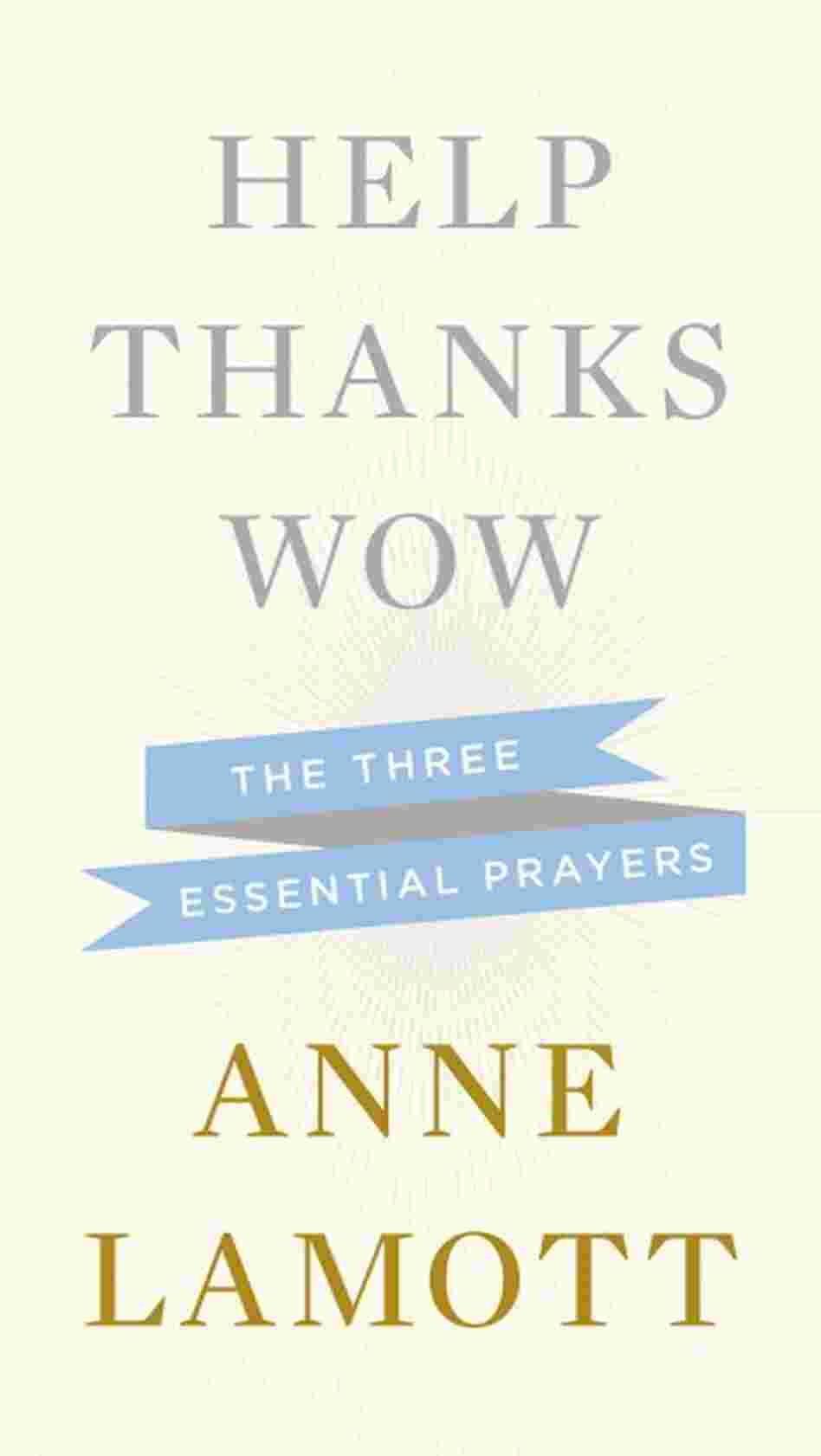
RevGalBookPals: Help Thanks Wow

It's the end of the year and most of us are pretty tired. Between Christ the King (or Reign of Christ) Sunday and Christmas Day, we have a marathon of services, hurdles of tradition versus new ideas, and a juggernaut of music, readings, plays, parties, and sermons. Panting, we come skidding into the Epiphany- hoping for a nap, inspiration, and a dearth of pastoral calls- in no particular order.

In all this, did you remember to pray?

Perhaps you did. Deep heartfelt prayers and quiet meditations. Rushed words tumbling out of your mouth in between activities. Memorized stanzas comfortable, familiar and consoling. Muttered phrases just upon waking and just before falling asleep. I hope that you got a few prayers in, but I trust that God heard all the prayers of our hearts and minds.

Knowing our need for rest and our need for prayer, I commend to you the very brief new work from Anne Lamott on prayer: Help, Thanks, Wow. (Lamott on Facebook and Twitter) The hardback edition has 102 slim pages and, like most of Lamott's writing, it goes down like your favorite food that also happens to be good for you (high in fiber or protein or what-have-you).

There is little research here on the history of prayer or the orans posture or even prayers of the Bible or other holy writings. Instead, Lamott ponders her own history in prayer- her way of communicating with God. She exposes her own soft underbelly by telling of how she speaks to God in the depth of pain, in great joy, and in times of deep need. In so doing, she draws the reader into a conversation about the reality of what prayer is and how it happens, rather than instructing on what prayer should "be".

Lamott writes:

God can handle honesty, and prayer begins an honest conversations. My belief is that when you're telling the truth, you're close to GOd. If you say to God, "I am exhausted and depressed beyond words, and I don't like You at all right now, and I recoil from most people who believe in You," that might be the most honest thing you've ever said. If you told me you had said to God, "It is all hopeless and I don't have a clue if You exist, but I could use a hand," it would bring tears to my eye, tears of pride in your, for the courage it takes to get real- really real. It would make me want to sit next to you at the dinner table. So prayer is our sometimes real selves trying to communicate with the Real, with Truth, with the Light.  (7) 

While many of us allow ourselves some realness in our own prayer lives, how do we communicate the power of truth-in-self-in-prayer to our parishioners and congregants? In our encouragement toward fullness in prayer lives (in prayer lives at all), what are the ways you've encouraged people toward honesty with God? It is not as though God does not know what we are feeling and thinking. However, for many- the utterance of despair and frustration and truly asking for help is a step too far out to be certain of one's footing. Yet, doesn't faith require some honesty? Shouldn't it promote the same?

Lamott describes three types of prayer: 1) help, 2) thanks, and 3) wow. In each section, she not only gives examples of her own experiences with these prayers, but also their presence in the lives of those around her. She details how expansive they may be and the honesty in their brevity as well.

On "help", Lamott says:

[W]hen we stop trying to heal our own sick, stressed minds... when we are truly at the end of our rope and just done, we say the same prayer. We say, "Help." We say, Help, this is really all too much, or I am going slowly crazy, or I can't do this, or I can't stop doing this, or I can't feel anything. Or, Help, he is going to leave me, or I have no life, or I hate the one I've created, or I forgot to have a life, or I forgot to pay attention as it scrolled by. Or even, Help, I hate her so much and one of my parents is dying- or will never die. Unfortunately, we haven't gotten to the big-ticket items yet: cancer, financial ruin, lost children, incontinence. (29)

We do often utter the most sincere prayers in flashes of grief, joy, and desperation. We know them to be true and we believe them to be heard. This is the gift of prayer- that it is not about getting it right, but getting it heard- getting it said- getting it out- and getting it to God. Our praying (or not) does not inhibit or permit God's own action in a given circumstance, but the act of praying does open us more to seeing the Holy Spirit, to releasing some of what holds us back, to being honest with ourselves, and thus more able to feel God's presence with us.

This tiny book makes a good conversation starter for any group or person in the difference between how we think we should pray and what we actually do. Possibilities for its use include a Lenten study, a book group, a spiritual counseling tool, or just a breather read between Christmas and Epiphany- little prayer primer in the time of Great Light. I do recommend this book to you. It's quick, but you'll find yourself thinking it over, returning to it, and (probably) quoting parts of it to yourself and to others. For Lamott's thoughtful work, I pray, "Thanks and wow."


Lamott, Anne. Help Thanks Wow. Penguin Group; NY, NY. 2012.

Monday, October 29, 2012

RevGalBookPals: A Year of Biblical Womanhood

It's rare that I read a book for this site that is as promoted as Rachel Held Evans's A Year of Biblical Womanhood. I excitedly received one of many advanced copies that were distributed to reviewers and bloggers. I planned to read the book anyway, because 1) I am always interested in theological experiments and 2) I think Rachel Held Evans is a powerful theologian who maintains an inspiring descant of openness against what can be the heavy beat of contemporary evangelical thought.

Before I even read my copy, I was already privy to the way Evans's own theological community, evangelicals, was reacting about her book. I do not want to link to negativity here, but there were those who were upset about her use of the word "vagina" in the book (it appears twice), those who accused her of mocking the Bible, those who already believe her theology does not fit the evangelical framework, and those who wrote with pity about her husband. Rather than support the book, which is fairly innocuous in its discussions of women in the Bible and of biblical interpretation and application, the backlash (I imagine) will just make people more eager to read it.

That's fine with me. The scholarship in this book reveals many lessons about biblical women and church history that may be ho-hum to clergy of all genders in mainline denominations, but it is likely to be very revelatory to those in the pews around us. Let's face it: most of us cannot be as loud as the evangelicals around us and Evans has done a commendable (and readable) job of making a book suitable for any Bible study- with brief sketches of biblical women, including Eve, Deborah, Tamar, Vashti, Mary of Nazareth, and Lydia, among others.

In her introduction, Evans talks about why she was considering undertaking a year of study and discernment as to what it means to embrace "biblical womanhood":

Now, we evangelicals have a nasty habit of throwing the word biblical around like it's Martin Luther's middle name. We especially like to stick it in front of other loaded words, like economics, sexuality, politics, and marriage to create the impression that God has definitive opinions about such things, opinions that just so happen to correspond with our own. Despite insistent claims that we don't "pick and choose" what parts of the Bible we take seriously, using the word biblical prescriptively like this almost always involves selectivity. 
After all, technically speaking, it is biblical for a woman to be sold by her father (Exodus 21:7), biblical for her to be forced to marry her rapist (Deuteronomy 22:28-29), biblical for her to remain silent in church (1 Corinthians 14:34-35), biblical for her to cover her head (1 Corinthians 11:6), and biblical for her to be one of multiple wives (Exodus 21:10).  
This is why the notion of "biblical womanhood" so intrigued me. Could an ancient collection of sacred texts, spanning multiple genres and assembled over thousands of years in cultures very different from our own, really offer a single cohesive formula for how to be a woman? And do all the women of Scripture fit into this same mold? Must I? (xix)
Her questions are very powerful and not so different or far from what many RevGals and Pals asked themselves upon entering (or attempting to enter) ministry. Many of us are still only the second or third generation of women clergy for denominations (those of us who are leaders as such). Others of us come from traditions that have honored women's leadership longer, but we may be first female leaders in our denomination or judicatory.

Evans goes on to set up her experiment with certain virtues, values, and tasks. She gives herself monthly goals, regular practices, efforts for the whole year: including submitting to her husband's will in all things, nurturing a gentle and quiet spirit, dressing modestly, refraining from gossip, and avoiding teaching in church. (xxii)

Evans's research is thorough. She consults different Bible translations and has several mentors, including a Jewish woman who gently steers her understanding and interpretation of Hebrew scripture and its intersections of worship and life. Her goals including various cooking projects, attempts at mothering, sewing enterprises, global travel, and submission are not undertaken tongue-in-cheek or with an idea that these things, done correctly, curry favor with God.

Instead, her projects reveal how quickly an attempt to create, achieve, and perpetuate a biblical standard can leave one frustrated and feeling distanced both from those one loves (and who love one in return) and, possibly, even distanced from God. Her struggle to "fulfill" the various tasks described in the woman of Proverbs 31 is a good illustration, both of Evans's own realizations and how she communicates what a reader can take away from the scripture:

The whole exercise had brought to the surface one of my most persistent insecurities- the fact that, despite having breasts and ovaries, I can't multitask to save my lief. I've always hated this about myself because the prevailing theory is that nature created all women everywhere to be accomplished multitasks so they can care for their young while simaltaneously fighting off predators, searching for water, and talking on their cell phones. Well, somebody forgot to let me in on this one. When confronted with a long and varied to-do list, I react more like a squirrel in the path of a car, frantically darting one direction and then another without actually getting anywhere besides the backside of a tire.
 I knew from my research that Proverbs 31 was never meant to be turned into a to-do list, but there was something about the spectacularity with which I was blowing this that beleaguered my confidence. Most women walk around with the sense that they are disappointing someone. This year, I imagined that Someone to be God. Though Proverbs 31 represented a poetic ideal, I couldn't shake the feeling that if these were indeed the accomplishments of a competent, capable, virtuous, valiant, and worthy wife, then I must be none of those things. (85)

Evans's realization that the proverb that so many women hear in part or in whole as a challenge was written or spoken from a mother to her son about the kind of wife he should choose. Maybe she was the kind of mother who thought (or knew) there would never be a good enough woman. However, the standard for a "woman of valor" was set for thousands of years or until women, like Evans, reclaim it for their own place and time and circumstances.

Ultimately, the power of this book lies in its readability and challenge to understand scripture from one's own context. This is not a kind of relativism, but a reality infused with and inspired by the Holy Spirit. Who is God calling me to be, in the time and place where God has put me, with the gifts I've been given, and the circumstances in which I find myself? How do I apply the values that Jesus espoused, values of generosity, peace-making, openness, solidarity, and gentleness, as a Christian- not just as a woman?

Evans makes a valiant attempt to stake a corner of the tent of feminist scriptural interpretation for the evangelical tradition. Many in that tradition will ignore or attempt to negate her efforts. Arguably, it's up to those of us who have found shelter in that tent for years to welcome her, to support her, and to salute her- "Woman of Valor!".

I strongly commend this book to your young adult classes or reading groups, to your adult studies (men and women), and for your own reading. There is a significant amount of supplementary material to the book found on Evans's website. I believe this was to limit the length of the book, rather than draw traffic.

The truth of this book, and of the time in which we are living, is that there are too many negative words and images that surround being female, being feminist, and being honest about one's own self, one's body, and one's experiences. We need all the voices we can raise, lest the rocks do our own work, to say that we are valued, gifted, and powerful creations of God- as much as any other work of creation. We have to do the simultaneous work that is Evans's struggle throughout the book: We must  1) work to forgive ourselves more easily and remind ourselves of the words of grace that come from God, but 2) be far more stringent with those who attempt to box us in, with impossible or painful standards, and who would say their words belong to God.

Monday, October 22, 2012

RevGalBookPals: When God is Silent

As a book reviewer, there is a hardly ever time to reflect back and give a little boost to a book you continue to use or mull over that might have been printed 5, 10, 15 years ago. There are always new books being published that need promotion (or panning) and discussion. There are new ideas pouring forth from pens and keyboards. Yet, many of us have old, sweet wells that we occasionally return to drink from, longing for the thirst-quenching imagery, structure, implications, and power of that certain book.

For me, one of these wells is Barbara Brown Taylor's slim volume: When God is Silent.   Among Taylor's many works, this is the only one I've read more than once. I have owned several copies and even purchased the electronic version for this review.

In this season of campaigning (in the United States) and struggle (around the world), I feel overwhelmed by the sheer volume of words that I (and, presumably, you as well) encounter every day. In all this sound, in all this information, in all this persuasion, I long for the voice of God. Not someone speaking for God, but to hear the stillness of thunder and the deafening of a whisper. Feeling overwhelmed a few weeks ago, I decided it was time, once again, to revisit these three lectures Taylor delivered in a series in 1997 at Yale Divinity School. It's powerful, thought-provoking, anguished, consoling, aggravating, lining stuff that I cannot recommend highly enough for anyone whose system feels overwhelmed.

Taylor addresses the topic of God's silence (or perceived silence) in three sections. The book is small and short, so none of the sections are very long. The first addresses the inundation of words that surround us each day. Despite being fifteen years old, Taylor's description of being swamped by words is even more true now than it was then. The second section deals with the biblical notion of God's silence. The third portion covers how preachers are to honestly address and bear the silence of God with and for their congregations.

Taylor begins with the powerful image of God speaking creation into existence:

But the most dangerous word God ever says is Adam. All by itself it is no more than a pile of dust- nothing to be concerned about , really- but by following it with the words for image and dominion, God sifts divinity into that dust, endowing it with things that belong to God alone. When God is through with it, this dust will bear the divine likeness. When God is through with it, this dust will exercise God's own dominion- not by flexing its muscles but by using its tongue.
Up to this point in the story, God has owned the monopoly on speech. Only God has had the power to make something out of nothing by saying it is so. Now, in this act of shocking generosity, God's stock goes public. "So God created humankind in his image, in the image of God he created them; male and female he created them"- human beings endowed by God with the power of the Word. (p.10)
This gift is the one that makes us co-creators with God, but is also the one that we use most often to create trouble- for ourselves and for others. The words, the very sayability, of our humanity are what often distract us, become our idols, and create the space that we long for God to make up... even though we keep spooling out the tape. Yet, despite the popularity of meditation, silent retreats, and quiet reflection, the  noises go on- around us and inside us.

No wonder so many of us are ambivalent about silence. Silence may suggest tranquility and awe, but it may also mean malfunction and death. Peace appeals to me, but not so much that I am ready to rest in peace. Making a little noise is how I remind myself that I am alive. (p. 31) 
For Christians, the use of words is how we have maintained connection to the Word, to God's presence among us, to the last time we are certain that God was speaking.

When the disciples spoke in the name of the Lord Jesus Christ, their words became acts. There was no vacuum between their saying and God's doing. When they spoke in the name of the Word made flesh, God came to earth all over again. 
In this way, a certain kind of speech became definitive for Christians. The name they used for God set them apart from those who used other names. What they said they believed about God could get them killed, but saying it was so important to them that many of them willingly chose death over silence. As time went one, they compressed what they believed into a short version that they could say together, and later they took their turns killing people who tried to say anything different about God... The Word was described, defined, delimited by words, so that what Christians said became more decisive than anything they did. (p. 32) 

"What they said became more decisive than anything they did." If that doesn't sum up contemporary culture, then I'm not sure what does. Most of us RevGals and Pals find ourselves preaching in the same culture in which we live, overwhelmed by words and trying to figure out, to receive the inspiration for, to dream about new ways of sharing the story we love to tell. Even the tools for creativity have stale descriptions, "thinking outside the box" and "keeping it fresh".

Our hearts, and the hearts we feed, long for God's word in God's voice. Yet, we do not always considering what we're requesting. The people of Israel heard the voice of God at Sinai and, immediately, turned to Moses and saying:

"You speak to us, and we will listen; but do not let God speak to us, or we will die" (Exodus 20:19. They were not up to a direct encounter. They wanted a mediator, and in that moment the ministry was born- an opening for someone to stand between the people and God, someone to take the heat, veil the light, buffer the voice, deliver the message in a human voice, so that the people could hear it without fainting from fear. (p. 37) 
Taylor's exegesis of God's growing silence in the Bible is very provocative. Her third section, the recommendations for pastors, is probably the weakest portion of the book. However, that does make it the weakest portion of a very strong book overall. I wholeheartedly recommend that you make the time to read these lectures, to ponder them, and to consider your own relationship to words, the Word, and the God we believe is still speaking, even when we do not hear.

I am considering reading this with adults in a more advanced study. While written for clergy, it is worth having a deep conversation as congregation and pastor about roles, words, and how we listen and speak for God. Your thoughts? Do you feel overwhelmed by words (after just reading a long review)? What are your thoughts on how people are able to hear God and God's promises over the relentless drumbeat of consumerism, patriotism, and information that washes over their lives? What is your own perspective on how God is still revealing God's Word(s) in the world?


Taylor, Barbara Brown. When God is Silent. Rowman & Littlefield Publishers, Inc. Lanham, MD. 1998

All citations taken from the Nook edition of the book.


Monday, September 24, 2012

RevGalBookPals: Sabbath in the Suburbs


Today we have a guest review by long-time RevGal Beth Birkholz, who blogs here. Her mini-bio: Pastor at Holy Trinity Lutheran Church in Marietta, GA.
Mama to M and J, Wife of S.  Suburban farmer, runner, and yogi.

She offers the following review of RevGal MaryAnn McKibben Dana's Sabbath in the Suburbs, which will be released in just 6 short days (September 30th). 
------

On the same day in which I received “Sabbath in the Suburbs,” I also received a notification that a book on my digital library list was ready for download, after a multiple-month wait.  I don’t want to slam that book….let’s just say that it involved a Project about Happiness.  It was well-reviewed and raved about by critics, and I was excited to read it personally and as a theologian.

I never made it all the way through that book, because I was busy getting practical suggestions about the happiness of myself and my family from MaryAnn McKibben Dana.  Whatever chord I was hoping that would be struck by the first book was far and away hit perfectly by “Sabbath.”

The author and I both have young-ish children, although mine are a bit older.  She embarks on an initiative of Sabbath-keeping throughout one year, springing from time at Iona, Scotland (from what I’ve heard from her and others, one of the “thin” places where God is a little more visible and present).  I mentioned this book to a Sunday School class of young parents, and their reaction was the same as mine: “Oh no.  There is NO FREAKIN WAY.”  That’s an actual quote.

I think we are all tempted to think the same thing when we read about Dana’s ambitious project: to set aside 24 hours (or so) for doing…..nothing.  Or a little something, but no hardcore cooking, no picking up socks, no errands.  Games are okay and some TV, but mostly to set aside the time to just BE, as a family.  My first thought was the same as hers: I’m a PASTOR. How am I supposed to set aside weekend time for this, when I have precious little as it is?

MaryAnn McKibben Dana addresses this concern: “This is why Sabbath is becoming important o my family.  On one day a week, I don’t need to be organized…on one day we simply get to be…and maybe engage in a monster tickle fight with our kids. And in doing so, we make a statement of faith: the tickle fight is as vital as our work is—perhaps even more so.”

Every concern I had, every snarky comment in my mind, she addresses them in the book in a way that shows me she struggled with them too and came out in a place where the Sabbath is still gifting her and her family with something that is worth every bit of the struggle.  I am hoping to use this book as a point of discussion with that same Sunday School class, to help us to view this commandment as they all are; something GOOD for us.

At the end of the book, I was so satisfied with where she ends up, and will end up referring back to this book if I dare take on this project.  After reading it, I cannot think of Sabbath in the same way.  It IS do-able, even for a pastor mama of two or three who is married and has a house to clean (what blessings! She is not unaware of this either).  And it’s do-able precisely because God gives us freedom.  She writes,

“True freedom, it seems, comes from participating in a particular pattern of life that seems restricting but is actually life-giving.”

Will my family engage in a Sabbath project?  The excuses are already crowding into my brain.  My kids are older.  We already take enough time away from them by being pastors on weekends.  Etc.  Etc.  But I can definitely move into what Dana describes as a Sabbath state of mind, even if it’s only for a few hours, an afternoon, a day.  The work of the Sabbath is life-giving, and MaryAnn McKibben Dana’s work on this book was life-giving and hopeful to this pastor mom in the suburbs.


Monday, June 25, 2012

RevGalBookPals: Summer Roundup

We're well into summer in the Northern Hemisphere and our Southern Hemisphere gals and pals are into winter. Regardless of the season you're experiencing, we can all use some recommendations. Earlier this week, I asked on the RevGals Facebook page what people were reading. Below is that list, in no particular order, but with a slight attempt at organization.

With all book recommendations, as with parables, your mileage may vary (YMMV). One person's beloved War and Peace is another person's @*!&!*^ War and Peace. Still, whether it's summer vacation or winter holiday, browse this list and share what's keeping you up at night in the comments below! There's always more to read!

Church Related (In Some Capacity) 
Keeping the Faith in Seminary
Scattering Seeds
Walking in the Valleys of Darkness
Wisdom Jesus
I Heart Sex Workers
Out of the Fog, Into the Sun
Still
Falling Upward
Called to Question
Follow the Path
Being with God (Journaling Series) 
Jesus Freak
Take This Bread 


Not Church-Related (But always potential sermon fodder)
Quiet
The Fault in Our Stars
Are You My Mother
A Wrinkle in Time
The Distant Hours
In One Person
Pride and Prejudice
Why Be Happy When You Can Be Normal? 
The Immortal Life of Henrietta Lacks
Dirt: The Ecstatic Skin of the Earth
Theophilus North
The Long Christmas Dinner and Other Plays
The Cabala
The Uncommon Reader
The Frugal Gourmet
The Art of Possibility
The Games of Thrones
Change of Heart
Wonder
The Chronicles of Narnia