
Last
year around this time, I bought a Fisher-Price nativity set to use with
children at church. Then my son absconded with it and now I do not know where
most of the set is. Last week, I said to my husband in regard to the set, “I have
not seen Jesus since March.” (What kind of pastor says that?) It’s true,
though. Within twenty minutes, I can find the most popular parts of the set at
our house (and maybe yours). All of the animals are in regular play rotation.
The donkey, the cow, the dog and the sheep all have roles in the pretend world
of toddler play at my house.
The animals that witnessed the
birth of the Savior of the world are bus passengers, log house residents, and
obstacles for trains and cars to pass just in time. This is the opposite of
what happens in most of congregations, wherein the animals are trotted out to
be sure everyone gets a part in the Christmas pageant and then we do not think
of them again. Perhaps your congregation has a Blessing of the Animals or
another service. Yet, what is the role that animals play in our theology and in
the lives of our congregations?
It was with this question in mind
that I read The Friends We Keep: Unleashing Christianity’s Compassion for Animals. Laura Hobgood-Oster
tackles the problematic history of how Christian theology became human-centric
and the very real notion that salvation for all means all creation, not simply
all humankind.
Early in the book, Hobgood-Oster
shares the story of the death of her dog, Beaugart. She explains his
significance to her life and faith:
Beaugart and I were companions in a relationship that I have no doubt was sacred. If anyone denies this, I will stand up and cite the most hopeful aspects of the history of the church and my understanding of God as a foundation to this claim calmly and surely: that God was made concrete in the relationship between Beaugart and me. With his death, I cried, I hurt, I grieved. But I would not have given up those years of companionship and joy for anything… I believe it is this connection, this gift of enduring presence and love, that is sacred. In these relationships we find God. (41)
For
those of us who have (or have had) companion animals of any kind, this passage
has a particular resonance. Even without a history with pets, many of us know
of someone whose animal is their support and comfort. Our connection to
companion animals is somewhat obvious, but Hobgood-Oster points out that
animals are still harmed in the breeding and marketing of pets. Puppy mills and
backyard breeding create unwanted animals that are often sacrificed in the
pursuit of having a “perfect pet”. Additionally, people often fail to research
breed or species specifics and end up with more than they expected. Many
animals that are born to be pets end up being killed because there simply was
not a place for them to go.
It
is easier to end lives when we view the “other” as wholly different from
ourselves. It has been this way between humans and animals for most of human
history, but it has also been this way between human beings. Hobgood-Oster
writes:
Since the earliest days of Christianity and before, sport that involved the bodies of “others”, a complicated category of those both human and animal thought to be expendable, was central to many dominant cultures, including those in the Mediterranean world. Some generalizations about such sports are part of popular Christian legend. We hear about “throwing Christians to the lions,” but the entire story is much more complicated. The dominant members of those societies would select those who were exploitable and expendable and put them into the gladiatorial arena for entertainment. In the first several centuries of the Common Era, as Christianity was growing slowly throughout the Roman world, those who chose this new religion often faced death alongside animals. (49f)
 |
| From here |
Instead
of Christians continuing in solidarity with their fellow victims, instead
history reveals the bullied becoming the bully. Slowly, scriptural
interpretation put human beings at the center of God’s will, God’s plan and
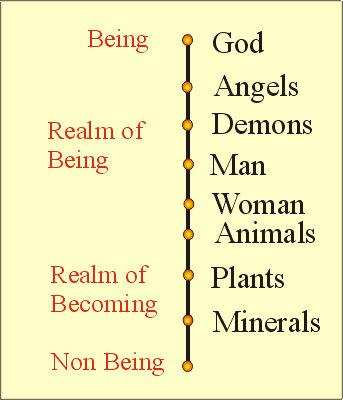
God’s salvation. Carrying forward from the Great Chain of Being through to the
Enlightenment, we became more focused on God’s work in the world being not just
primarily, but solely for and
through people. Hobgood-Oster argues that this has happened for a variety of
reasons, two of which are increased emphasis on the Word (which involves speaking and hearing as human constructs) and the loss of saints’ hagiographies
in common discussion and awareness. She shares many stories from St. Francis
and the wolf to St. Brigit and the dog to the ox and ass adoring the infant
Jesus in the manger.
All of these wonderful stories of saints with animals speak loudly to the radical extension of Christian hospitality to all animals… Each of these holy people was closely connected to animals and sought after their well-being; they extended hospitality to the entire creation. Also, as these stories attest, though it has often gone unnoticed in the history of Christianity, humans are not the only ones who offer hospitality. Other animals do so as well, providing safety, food, and companionship to humans. (126)
As
I was reading the book, I had to wrestle with my own internal misgivings each
time the author introduced a new story from the lives of the saints. I am not
crazy about hagiography and I kind of grind my teeth at the idea of all these
animals and people, miraculously living together. Then it dawned on me that
this was precisely the point that Hobgood-Oster is trying to make. The time has come to bold in our proclamation of God for all, if this is what we truly believe. Not just all humans, but all creation-from the fluffiest and most photogenic to the tiniest and least visible.
 |
| Re-imagined Great Chain of Being Showing the Interconnectedness of All |
People
will dismiss charity to animals or broadening theology to include salvation to
all creation by saying that animals do not have reasoning ability (not true),
do not have feelings (not true), or are not as important as people (not true).
If we ignore the most vulnerable around us (arguably animals), we can easily
make the leap from ignoring animals to ignoring people who are somehow less
functioning members of society (however that’s determined). As Christians,
either every aspect of our live is connected to our faith or none of it is.
What’s it going to be with regard to animals?
According
to Laura Hobgood-Oster,
If God is incarnated in Jesus, does that event point to God’s incarnation in all bodies and all creatures? With this deep concept of divine incarnation undergirding the tradition, Christianity is necessarily a religion of compassion; because we are all, humans and others, connected to and in relationship with each other, the God exemplified by this incarnation embodies an ethic of care… While Christianity has historically been a religion of orthodoxy (of right beliefs), when issues of compassion are paramount, it must function as a religion of orthopraxy (of right practice). Right Christian practice in the contemporary world, with the many suffering animals in our midst, calls us to alleviate that suffering and to extend compassion, hospitality, and mutual relationship to all of God’s creatures. (170)
Within The Friends We Keep, Hobgood-Oster also has discussions around
horse-racing, dog-fighting and trophy hunting. She includes a provocative and
informative chapter on animals as a food source and the uncompassionate ways
they are raised until slaughter. Her language is usually straightforward and
each chapter stands well on its own, making this a fine book for a multiple
session study. She includes discussion questions, ways to respond and become
involved and liturgies for animal blessings and funerals. This is an
exceptionally long review for a very stimulating book.
So, Rev Gals and Pals, has your
congregation expanded its theology to include animals? If so, how did you do
it? What are your thoughts on the relationship between how we treat animals and
how we treat people? What are your suggestions on how to meet the question,
“But aren’t people more important”? Do you think this book is way off the mark
or are you putting it on your wishlist today?
RevGal Amy Forbus interviewed Laura Hobgood-Oster about this
book and you can read that interview here.
Hobgood- Oster, Laura. The
Friends We Keep: Unleashing Christianity’s Compassion for Animals. Baylor
University Press; Waco, TX. 2010
This book was received from Baylor University Press for
review. No compensation was offered to the reviewer, other than the book. No
promises were made in exchange for a review copy.